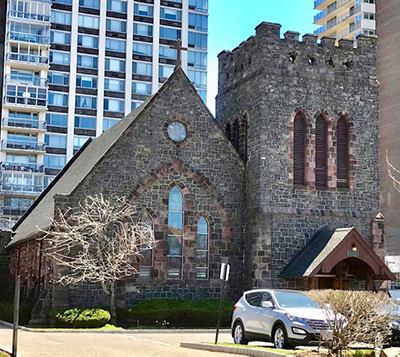
Sermon 9/27/2026 By Rev. Juhyung Choi

Putting First Things First

Last Friday was Chuseok, the Korean harvest festival. Across much of East Asia, families gather around this time of year to share food and give thanks for the season. Even those who don’t celebrate Chuseok know the feeling of pausing on a special day to think of the people we owe thanks to. But gratitude often waits. We tell ourselves we’ll call when things settle down, or bring it up next time we meet. Then life gets busy again, and whatever we meant to say slips away. We say that our family and our faith matter to us more than almost anything else. We mean it. Yet when we look back over a day, we often find we gave no real time to the very things we called precious. Holding on to what matters, in the actual shape of our days, turns out to be harder than it sounds.

In today’s gospel, a father sends his two sons out with the same instruction. “Son, go and work in the vineyard today.” The first son refuses. The second says he will go. But the first later changes his mind and goes to work, while the second never does. Jesus asks the question directly: “Which of the two did the will of his father?” The answer isn’t hard. It’s the one who went to work. He said no at first, but then turned his heart and did what his father asked. We’re not told why the second son never went. Maybe he never meant to. Maybe something else came up and he forgot. What we do know is that his word stopped short of his feet. We’re not so different. When we say we’ll do something, we usually mean it at the time. Once this is finished, once things are easier—then we’ll get to it. In the meantime, the intention just stays an intention. Jesus told this parable to the chief priests and elders—people whose whole vocation was serving God. Yet when John the Baptist showed them the right way, they didn’t believe him. The ones who did believe were the tax collectors and the prostitutes, the very people the religious leaders looked down on. Agreeing with a teaching isn’t the hard part. The hard part comes when it asks us to change our plans, or costs us something. We can pray for a certain kind of life and still, when the moment to decide arrives, reach first for our own comfort. The first son changed course and went to the vineyard. His change of heart showed up in what he did next. If we’ve truly reconsidered what matters to us, something in how we act should follow.

One of my favorite films is The Mission. In it, a man named Rodrigo Mendoza has spent years capturing and selling indigenous people into slavery. In a fit of rage, he kills his own brother, and is left afterward with a crushing guilt. There’s a scene where he drags a heavy bundle of armor and weapons behind him up a punishing mountain trail—toward the very people he once hunted. When he finally reaches them, one of them cuts the rope holding the bundle. It falls away, and Mendoza breaks down in tears. That weight was his old life—the life in which he threatened, captured, and sold human beings. Now he is received by the people he once harmed, and begins to live among them. Mendoza doesn’t stop at regret. He learns to live for the people he once treated as goods to be sold, sharing his life with them. In the end, he dies defending them. What changed in him was the answer to a simple question: who am I living for? Before, he sacrificed others for his own gain. Afterward, he gave his own life for theirs.

In today’s reading from Philippians, Paul writes: “Let each of you look not to your own interests, but to the interests of others.” What we put first shows up in our choices. We may believe that helping others matters, and still hesitate the moment it costs us our time or our money. Sometimes loving someone well means letting go of an opinion we’ve held onto, or a habit we’ve grown comfortable with. This is true even within families. When we’ve lived alongside someone for many years, we assume we know them well. But time changes bodies and circumstances. Something a person once managed easily may now be difficult. Something that once seemed minor may now be a real worry. Even parents who have given everything to raising their children still have new things to learn. Once children are grown, love has to change shape— from deciding to listening. If our words start to sound like interference, the answer isn’t to explain ourselves more insistently, but to ask honestly whether what we call help is actually helping. Caring for the people who matter to us sometimes asks us to change a way of thinking we’ve long taken for granted. Paul continues: “Let the same mind be in you that was in Christ Jesus.” Christ emptied himself and took the form of a slave. He humbled himself and became obedient to the point of death. His love took the shape of a life given away. If we carry that same mind, our choices should show it. If we’ve always reached first for our own convenience, there will be times we need to rearrange our plans, and carry some real cost, for someone else’s sake. It’s worth asking, honestly, what we are actually giving for the things we say matter to us.

Our days are full of things that genuinely need doing—work to make a living, keeping a home together, the people we’re responsible for. None of that is wasted, and there’s no need to blame ourselves simply for having been busy. Still, it’s worth asking whether the things we’ve grown used to doing are still the most necessary ones. As seasons of life change, so does what comes first. Some things may need to be set down, so that time can go to someone we’ve been neglecting. If our bodies can’t carry as much as they once could, we can still do what’s within reach. We can pray for someone, or simply ask how they’re doing. If we need help ourselves, we don’t have to carry it alone—we can ask. Each of us, in our own circumstances, can look for our own way to follow God’s will. I hope gratitude, too, can become something we act on. We live surrounded by the help of family, neighbors, and fellow believers. We can thank the people who have stood by us, and take up a portion of the burden someone else has been carrying alone.

The father tells his son to go to the vineyard today. Our time isn’t unlimited. Changing our hearts, and then living that change out, takes time. Coming close again to a relationship long left unattended takes time as well. Keeping this up isn’t easy on our own. That’s why we need God’s help. As Paul writes: “It is God who is at work in you, enabling you both to will and to work for his good pleasure.” God gives us both the desire to follow his will and the strength to carry it out. Even as we recognize what needs to change in us, and try to act on it, we can ask for that help. I hope we can each take a moment to consider how we are caring for the people who matter to us. May we find ways to speak our gratitude, and to give our time when someone needs us—so that the love we speak of becomes something we actually live. Amen.

Sermon 9/20/2026 By Rev. Juhyung Choi

Love That Resists Absurdity

As a child, I did not read very much. I began to read more around the time I entered college. I read especially often during my military service. I served at a guard post on the front line, along the border with North Korea. Life there was simple and repetitive. Most days were much the same. Whenever I had a little time, I would read. Back then, I preferred books that explained ideas and theories. I thought reading was worthwhile when it gave me new knowledge. Novels and poetry did not interest me much.

But as I grew older, that began to change. Especially after I turned forty, I found myself enjoying novels more. Through novels, I could get a glimpse of lives I had never lived. A character might be hard to understand at first. But as I followed what that person went through, I began to see them differently. I might still disagree with what they did. Yet I could begin to understand why they did it, and I became a little slower to judge. This has helped me in ministry, too. When we sit with people and listen to their stories, we often discover things we could never have known just by looking at them.

Recently, I reread The Stranger by Albert Camus. The novel begins with the death of a mother. The main character, Meursault, cannot say for certain whether his mother died today or yesterday. At her funeral, he does not show his grief in the way people expect. He seems more aware of the hot sun and his own tiredness. Some time later, he kills a man on a beach. At his trial, people judge him not only for the killing, but also for how he behaved at his mother’s funeral. Again and again, they raise the question of why he did not cry. He is responsible for the killing. But as people judge that crime, they also condemn him for failing to grieve in the way they expected.

But when Camus speaks of “the absurd,” he means more than the way society judges people. We 

 want to understand our lives. We want to know why something has happened and what our suffering means. When someone who has lived an honest life suffers a terrible loss, or when someone we love dies too soon, we struggle to understand. We ask, “Why did this happen?” Yet sometimes, however often we ask, no answer comes. We search for meaning, but the world gives us no answer. Camus called this clash between our need for meaning and the silence of the world “the absurd.” Those of us who have faith know this experience, too. There are things we cannot understand, even as we pray. Some questions stay with us for a long time.

Today’s Gospel does not answer that question directly. But here, too, things do not happen as we expect. There is a difference between what we consider fair and what the owner of the vineyard does. Jesus tells us about workers hired for the day to work in a vineyard. Early in the morning, the owner goes out and sends workers into his vineyard. He goes out again at nine, at noon, and at three, and hires more workers. Then, at about five, when the day is almost over, he returns to the marketplace. There are still people standing there. He asks them, “Why are you standing here idle all day?” They answer, “Because no one has hired us.” That answer stays with me. We remember them as the people who worked for only one hour. But before that hour of work, they had spent hours unable to find work. As others were hired and went off to work, these people were still waiting in the marketplace. They may have worried that once again they would have to go home to their families empty-handed. The owner says to them, “You also go into the vineyard.”

When evening comes, the owner has the workers paid, starting with those who came last. They receive a denarius, a full day’s pay. It is the same amount he promised those who began early in the morning. The first workers see this, and their hopes rise. If those who worked only one hour receive that much, surely they will receive more. But they, too, receive a denarius. They receive what they were promised. Still, they are angry. They have worked through the heat of the day, yet they are treated just like those who came late. We can understand how they feel. It is natural to expect more pay when we have worked longer. Jesus knows how hard they have worked. But the owner says, “I choose to give to this last the same as I give to you.” The first workers are not upset because the owner has given them less than he promised. They are upset because he has been generous to someone else. Their own pay has not changed. But once they see what others have received, they are unhappy.

We find something similar in Jonah, in today’s first reading. Jonah is angry because God has forgiven Nineveh. Nineveh was an Assyrian city. For the people of Israel, it represented a cruel and powerful enemy. For Jonah, Nineveh was not easy to forgive. Yet God has mercy on that city. Jonah goes outside the city and sits down. When the bush that has given him shade withers, he becomes deeply distressed. God reminds Jonah of his concern for the bush. Then God asks, “And should I not be concerned about Nineveh, that great city, in which there are more than a hundred and twenty thousand persons who do not know their right hand from their left, and also many animals?” Even in the city Jonah hates, there are lives God cares about. We believe in God’s mercy. But when that mercy reaches someone we find hard to accept, our feelings become more complicated. The forgiveness we desperately needed may seem far too freely given when someone else receives it. We can find something of ourselves in Jonah and in those first workers.

In daily life, we weigh work and reward. We need to consider how much work someone has done and what responsibilities they have carried. There is nothing wrong with asking for fair pay. But we cannot judge a person’s worth by how much work they have done. Working fewer hours does not make someone less hungry. Not being hired does not make that person’s day any less important. The owner of the vineyard goes out to find the person still waiting in the marketplace. And he gives that person a full day’s pay. The first workers see only one hour of labor. The owner wants to be generous to that person, too. Sometimes, when we see someone receiving help, our first question is whether they have done enough to deserve it. We may know very little about the difficulties they have faced. While we compare what we have received with what someone else has received, we fail to see what life is like for the person still standing there empty-handed.

I would like to return to the question we began with. We do not fully understand why some people suffer so much. Having faith does not mean we can explain every illness, every death, or every loss. Camus and the Christian faith do not give the same answer to this problem. But we, too, have to ask how we are to live with questions we cannot resolve. In today’s readings, God calls the people no one has hired and cares for the lives in the city Jonah wants to see destroyed. God cares for people we have failed to notice, or have not wanted to see. And we who believe in this God have something to do.

Even when we cannot explain why someone is suffering, we can listen to their story. Even when we cannot solve all their problems, we need not leave them to face those problems alone. Love begins when we listen patiently to someone others have rejected, and share a little of what we have. I believe this love is our Christian way of resisting the absurdity of the world. We refuse to add our indifference to suffering we cannot explain. Even as the day was ending, the owner went back to the marketplace. There were still people there. I hope we can do the same.

Amen.

Sermon 9/13/2026 By Rev. Juhyung Choi

A Heart Growing Wider

Since I was young, I have learned many new things. Over the years, I have come to see that some of the most important lessons go beyond the knowledge I have gained. I am still learning these lessons today. One is that people can look at the same question and see it very differently. I have also learned that I need to listen to those who see things differently from me. At first, when I heard something I disagreed with, I would look for what was wrong with it. But as I continued to learn, I slowly began to change. Other people asked questions I had never thought to ask. They saw things I had missed. Sometimes, after listening carefully, I realized that I was the one who needed to change my mind.

Faith can be like that too. When I was younger, it seemed easier to speak about God. I could say more easily what God is like, what God wants, and what pleases God. As I grow older, I find myself more careful about saying such things. What I have learned and experienced is not enough for me to say that I fully understand God. Someone who has walked a very different path from mine may know a depth of faith that I have never known. And yet, the longer we live our life of faith, the easier it can sometimes be to lose this humility. We may begin to treat our own conclusions as if they were God’s will. Once we have placed God’s name upon our own judgment, it becomes difficult to listen to anyone else. It also becomes difficult to ask whether we ourselves might be mistaken. So growing deeper in faith may not simply mean becoming more certain about more things. It may also mean learning not to judge people too quickly and being willing to admit that there is still much we do not know.

I learn this from raising my children as well. Parents have watched their children since they were very young, so we naturally think that we know them better than anyone else. And in many ways, we do. But we do not know everything. Our children have thoughts they have not shared with us. They have relationships and experiences that we do not fully know. They find joy, they are hurt, and they grow up in a world that remains partly hidden from us. The path that seems right to me may not always be the best path for them. Sometimes I need to listen longer before I can understand. Because we love our children, there is much we want to teach them. But loving them does not mean that we know everything about them. In fact, the closer someone is to us, the more important it may be to remember that there are still things we do not know. When we think we know someone completely, we also tend to judge that person quickly.

This connects with what Jesus teaches us about forgiveness in today’s Gospel. It is not easy to accept someone who thinks differently from us. But it is even harder to forgive someone who has actually hurt us. In today’s parable, the slave looks at his fellow slave and sees only a man who owes him money. But when the man pleads, “Have patience with me, and I will pay you,” he is saying almost the same words that the first slave had just spoken to his own lord. Then the lord asks him: “And should you not have had mercy on your fellow slave, as I had mercy on you?” In other words: Were you not also someone who needed mercy?

When we look at another person’s wrongdoing, the wrong is usually what we see first. But when we look at our own mistakes, we tend to remember the circumstances. We remember that we were going through a difficult time. We were tired. We were under pressure. We had our reasons. None of this makes the wrong disappear. But what we know about another person may not be the whole story. Before we judge that person, we need to remember that we too have come this far because others have shown us patience, understanding, and mercy. Forgiveness requires our hearts to grow wider in this way. It means that we do not look only at the wound we received. We also remember that we have lived because others understood us, waited for us, and gave us another chance. This is what Jesus asks us to remember in today’s parable. I too am someone who needs mercy. I too live by the mercy of God.

We see something similar in the story of Joseph and his brothers. Joseph says to them: “So have no fear; I myself will provide for you and your little ones.” Joseph had not forgotten what his brothers had done to him. But he no longer saw them only as the brothers who had sold him into slavery. Now he could also see that they had grown older. They were afraid, and they had families who depended on them. Joseph did not look only at the suffering he had endured. He could also see how God had been at work through all those years, leading him and preserving his family. So instead of taking revenge, Joseph chose to care for his brothers and their children.

Of course, it can take a long time for a heart to change in this way. If someone has hurt us deeply, we do not need to force ourselves to forgive immediately. Sometimes we need to hold someone accountable. Sometimes we need to protect ourselves. But we do not have to assume that the way we feel and judge today must remain the same forever. There are people we once could not understand at all, but years later, we may begin to see them differently. It may not be because they have changed. It may be because we have lived through more of life ourselves and have begun to see more than we could see before.

This may be part of what faith does within us. As we come to know how patiently God has waited for us, and how graciously God has received us even in our weakness, the way we look at other people begins to change. Growing deeper in faith may not be measured by how much we can say about God. It may be seen in how slowly and carefully we judge another person. Once, all we could see was what that person had done wrong. In time, we may begin to see more of the person. Along with the hurt we carry, we may also remember how much patience and mercy we ourselves have received. This is how our hearts slowly grow wider. As God has been patient with us, may we learn to look at one another more deeply and with greater understanding. And as our faith grows deeper, may our hearts grow wider with it.

Amen.

Sermon 8/30/2026 By Rev. Juhyung Choi

A Wider Way

In last Sunday’s Gospel, Peter made a very important confession about Jesus. “You are the Messiah, the Son of the living God.” Jesus accepted Peter’s confession. In today’s Gospel, this same Peter receives a sharp rebuke from Jesus. Jesus tells his disciples that he must go to Jerusalem, suffer, and be killed. When Peter hears this, he takes Jesus aside and tries to stop him. “God forbid it, Lord! This must never happen to you.” Then Jesus says, “Get behind me, Satan! You are a stumbling block to me.” These are very strong words.

Peter had been imagining a new future with Jesus. Crowds were following Jesus. The sick came looking for him. Peter must have felt proud to be known as one of his disciples. If the teacher rose, perhaps the disciples would rise with him. Now that teacher suddenly begins to speak about dying. For Peter, this meant losing someone he loved. It also meant watching the future he had counted on fall apart. His alarm is understandable. Jesus answers, “You are setting your mind not on divine things but on human things.”

Peter did not want his teacher to die. He wanted someone he loved to be safe. There was nothing wrong with that desire itself. The trouble begins when that desire becomes the measure of everything, even the path Jesus must take. If Jesus was truly sent by God, surely he must not die. If this was truly the right path, surely it must not end in failure. None of this is foreign to us. Every living thing tries to protect itself. We want to avoid danger. We would rather gain something than lose it. The desire to protect ourselves is natural. Yet it cannot become the final measure of our lives. Is this good for me? Will this keep me safe? What might I lose? When these questions become too powerful, we begin to judge even the way of God by them.

Jesus then says, “If any want to become my followers, let them deny themselves and take up their cross and follow me.” These words are easily misunderstood. Deny yourself. Give up what you want. Let go of your own happiness and live only for others. If this is how we understand faith, an honest question arises. Can anyone really live that way for a lifetime? If I must keep giving up what brings me joy, where will I find joy at all? There may be an assumption hidden in that question:  that my happiness and another person’s happiness are entirely separate. Real life does not work that way.

Parents give their time and money for their children. Sometimes they sleep less. Sometimes they put aside something they wanted to do. Yet we do not think of all this simply as a loss of our own happiness. That is because the joy of our children has already become part of our joy. When a child is happy, the parent is happy too. Parents do not count every effort they make for their children as a loss. Love redraws the line between ourselves and another person. It becomes difficult to divide clearly what is for me and what is for the other person.

This helps us hear the words “deny themselves” in a different way. It does not mean that I must erase myself. It means stepping down from the place where I believe I must be at the center of everything. Faith may not mean losing all concern for ourselves. It may be the process by which what we count as our own concern begins to change. Something that once seemed to belong only to someone else’s life no longer seems entirely separate from us. The joy and pain of people who once meant little to us slowly enter our own lives. In the end, what matters most may not be how much we have given up, but what we have come to love. When we begin to love what God loves, and when what mattered to Jesus begins to matter to us, faith is no longer an outside command forcing us to sacrifice ourselves.

If our faith does nothing more than protect us and those on our side, we need to stop and think. Faith may sound noble and holy. But if it serves only us and our own circle, we must ask whether it is truly the way of Jesus. Peter came to such a moment. There was no conflict when he confessed that Jesus was the Messiah. The conflict began when the path Peter expected and the path Jesus chose no longer matched. Peter could see only the road he already knew. Jesus was showing him a wider way.

We live within nations, cultures, and religious communities. They are precious to us. Yet the boundaries we create are not necessarily God’s final boundaries. We can see this in our own time. When the desire to protect “us” becomes too strong, we can easily overlook the suffering of “them.” Even now, people are dying in many parts of the world because the security of one nation or the interests of one group have been treated as absolute. At that moment, Peter’s world had also become small. His teacher must survive. Their community must not fall apart. Jesus was looking beyond those limits. And it is here that Jesus speaks about the cross.

For us today, the cross is a familiar religious symbol. In the time of Jesus, it was an instrument of death. A person condemned to crucifixion was sometimes made to carry the crossbeam to the place of execution. So the command to take up the cross and follow was never a light or comforting one. The central point, however, is not suffering itself. Jesus did not desire the cross. He did not go looking for pain. What Jesus refused to abandon was the work of bringing life to others, reaching out to those who had been pushed aside, and proclaiming the kingdom of God. He followed that path to the end, and the cross was the result. The heart of the cross, then, is not suffering but following. As we follow Jesus, there will be moments when what we are holding on to comes into conflict with the path he is taking. At that moment, the cross is no longer a distant religious story. It enters our own lives.

Jesus says, “For those who want to save their life will lose it, and those who lose their life for my sake will find it.” We hold tightly to many things because we want to protect ourselves. We want to protect our position, our security, and even our certainty that we are right. Yet a life held tightly is not necessarily a life kept safe. We can hold on to many things and still find that our lives have become smaller. Perhaps this is where we begin to understand the strange truth in Jesus’ words about losing and finding. When I step down from the place where I must be at the center of everything, I begin to see people whom I could not see before. What once seemed to be someone else’s concern no longer seems entirely separate from me. To take up our cross and follow Jesus is to cross that boundary with him. Along that way, we may lose something. But within that loss, we receive a wider and fuller life.

Amen.

Sermon 8/23/2026 By Rev. Juhyung Choi

Who Do You Say That I Am?

In today’s Gospel, Jesus and his disciples came into the district of Caesarea Philippi. This city bore the name of the Roman emperor. On one side of the city stood a cave shrine dedicated to Pan, a Greek god believed to watch over fields and forests, shepherds and their flocks. There, imperial power and the worship of many gods were on full display. It was there that Jesus asked, “Who do people say that the Son of Man is?” The title “Son of Man” points to Jesus as one who came among us as a human being. At the same time, it echoes the book of Daniel, where it refers to one who is given authority by God. Jesus was asking who people thought he was.

The disciples answered, “Some say John the Baptist, but others Elijah, and still others Jeremiah or one of the prophets.” Then Jesus asked them again, “But who do you say that I am?” Knowing what others say about Jesus is not the same as believing for myself who Jesus is. Knowing what Scripture and the Church teach is not the same as knowing what those teachings mean in my own life. Peter answered, “You are the Messiah, the Son of the living God.” Jesus responded to this confession by calling Peter “the rock.” He called him that before Peter had become like a rock. In a city that bore an emperor’s name, in a place where many gods were worshiped, Peter turned away from the power before his eyes and confessed Jesus as the true Messiah.

But when Jesus said that he must go to Jerusalem, suffer, and be killed, Peter objected, saying that this must never happen. The same man who had just confessed Jesus as the Messiah now stood in the way of the path Jesus would take. Peter knew the word “Messiah.” He did not yet understand the road the Messiah would walk. The words were right. Their meaning had not yet sunk in. And so the confession had not yet become his life.

We confess our faith in God with words. We learn the teachings of Scripture, and we share what we believe with others. Yet knowing these words does not mean that we understand them. The words we receive must become part of our own understanding. We should be able to express what they mean in our own words. And as we live by them, our understanding grows deeper.

For many years, we have used many familiar words in the Church: Jesus, God, salvation, eternal life, the kingdom of God, the gospel, grace, and faith. These words are at the heart of the Christian faith. Because they are so basic, we often assume that we already understand them. Within the Church, we seem to understand one another without having to explain them. We can use these words as the foundation of our conversation without stopping to ask what they truly mean.

But what would we say if someone asked us directly? “What does it mean to be saved?” “What does it mean for the kingdom of God to come?” “Why is the gospel good news?” We may find these questions harder to answer than we expected. We say that salvation comes by grace, and that grace is received through faith. This is not wrong. If someone then asks what grace means and what faith means, our answer may return to where it began. Instead of becoming clearer, one familiar word simply points to another.

Using familiar religious words often does not prove that we understand them. Even after many years in the Church, these words may still remain unclear. Imagine someone who knows nothing about Christianity asking us, “Who is God?” “What does it mean to believe?” “What is salvation?” We need to do more than repeat the expressions we have learned in church. We should be able to answer in our own words. Today’s Gospel asks us to consider: Are the words I use truly my confession? Have I thought carefully about what they mean? How is that confession shaping my life?

There is mystery at the heart of Christian faith. We cannot fully explain God with human words. Explaining what we believe does not mean solving the mystery of God. Not knowing everything about God is different from believing vaguely, without serious thought. We cannot put God fully into words. Still, we must think seriously about the God in whom we believe. What we believe must take shape in our time and work, in our relationships and service, and in the care we offer each day. The Church is where we learn the language of faith. It is also where we seek its meaning together and put it into practice in the way we live.

When Jesus called Peter “the rock,” it was not praise for something Peter had already become. It was a calling toward the person he would become. Yet later, Peter was overcome by fear and denied Jesus three times. But his story did not end with that failure. The risen Jesus came back to him. Three times he asked, “Do you love me?” Then he entrusted his sheep to Peter’s care. In the place of Peter’s failure, Jesus raised him up again. Through failure, forgiveness, and restoration, Peter learned what his own confession meant. Over many years, that confession slowly became his life.

In today’s reading from Romans, Paul appeals to us “to present your bodies as a living sacrifice, holy and acceptable to God, which is your spiritual worship.” To offer our bodies is to offer each day of our lives to God as worship. Our confession of salvation should lead to a life that gives life to others. Those who seek God’s kingdom honor those in lowly places and work to restore broken relationships. A life that makes room for others to begin again—this is what the gospel looks like. This is grace at work.

Faith, in the end, means following the road that Jesus walked. Then the words of faith will no longer be empty sounds that fade into the air. Who we confess Jesus to be is revealed by the way we live. This is not an answer we finish all at once. It deepens little by little as we follow Jesus.

Today Jesus asks us the same question: “But who do you say that I am?” Who is Jesus to you? We begin by answering in our own words. Then we spend our whole lives learning what that answer means and living it out.

Amen.

Sermon 8/16/2026 By Rev. Juhyung Choi

A Church Beyond Boundaries

During our vacation, my family and I stayed at campgrounds in Maine and Connecticut. There were many people around us. Other families were staying right beside us and across from us. Each campsite was marked off by thick wooden posts. I paid close attention to those boundaries. I tried not to get too close to them, and I was careful not to disturb our neighbors with noise or activity. On the last day, as we were leaving, I waved to the family at the campsite next to ours. They smiled and waved back. It was only a brief moment. But as we drove away, I found myself thinking about something. We had stayed right next to each other for several days. Yet we had been so careful not to bother one another that we had never really gotten to know each other.

Boundaries are necessary. Respecting another person’s space is part of caring for them. But when all our attention goes toward keeping the boundary, we can live right next to one another and still remain strangers. There are boundaries in today’s Gospel as well. Jesus leaves Galilee and goes to the region of Tyre and Sidon. He moves beyond the familiar world of Jewish life into a region where many Gentiles lived.

There, a woman comes to him. Matthew calls her “a Canaanite woman.” That was not the ordinary way to describe someone in Jesus’ time. In the Gospel of Mark, the same woman is described as Syrophoenician. But Matthew reaches back for an older and heavier name: “Canaanite.” In Israel’s long history, the Canaanites were remembered as a people distinct from Israel. They had lived close to one another and had influenced one another. But their religious and cultural traditions were different, and at times they had been in conflict. And now a woman from beyond that old boundary comes to Jesus.

Unexpectedly, she calls out, “Lord, Son of David.” A Gentile woman, someone considered an outsider, recognizes who Jesus is and comes to him in faith. She pleads with him for her suffering daughter. But at first, Jesus does not answer her at all. Still, she does not leave. She keeps following and crying out. Then the disciples say, “Send her away, for she keeps shouting after us.” To them, she was a stranger. And she continued to stay near them, asking for help. The disciples say, “Send her away.” Her persistent cries must have made them uncomfortable.

But it is exactly here that an old boundary becomes an encounter with a real person. The Gospel asks us how we see the person standing before us. Do we see only the old name, the difference, and the boundary? Or do we see the person who is asking to be heard? The woman continues to ask for help. Jesus says, “It is not fair to take the children’s food and throw it to the dogs.” But she does not give up. She answers, “Yes, Lord, yet even the dogs eat the crumbs that fall from their masters’ table.”

She trusts that God’s mercy can reach even her. She asks for no place of honor. She asks only for mercy for her daughter. And she believes that even a crumb of God’s mercy is enough to bring life. Finally, Jesus says, “Woman, great is your faith! Let it be done for you as you wish.” At the beginning of the story, she is introduced as “a Canaanite woman.” That name carries an old history and an old boundary. But that old name does not have the final word. Her faith does. The woman whom others saw only as a stranger is remembered in the Gospel as a woman of great faith.

Our church has an English-speaking congregation and a Korean-speaking congregation. Our languages are different. The hymns we know and the cultures in which we have lived are also different. So we need to respect one another. But respect does not mean that we must always remain at a careful distance from one another. Even if we do not understand all the English, we can attend the English service. Even if we do not speak Korean, we can sit at a table prepared by the Korean congregation. We can ask the name of someone we do not know. And when words do not come easily, a smile and a greeting can be where we start.

In East Asian architecture and garden design, there is a concept called chagyeong (借景), or “borrowed scenery.” A mountain, a tree, or a stretch of sky beyond a garden wall is allowed to become part of the beauty of the space within. You do not own what lies beyond the wall. And you do not have to tear the wall down. The boundary remains. But the beauty beyond it becomes part of the life within. The space becomes richer because of that relationship.

I think a church can be like that. We can keep our different languages and traditions and still open ourselves to one another. We do not have to erase every difference between us. We can allow the life of others to become part of our life together. And when we do that, our community becomes richer. This is not only about the English-speaking and Korean-speaking congregations.

After this service, Joyful Church will worship in this same space. During the week, daycare teachers, children, and parents come through these doors. Another faith community gathers here on Wednesdays, and an AA group meets here on Fridays. Each group’s time and space deserve respect. But I hope we will not think of them only as “people who use our building.” They are people who enter the same doors, walk through the same rooms, and gather beneath the same roof. I hope the different people who come through this place can gradually come to know one another. I hope they can feel that they are not merely using a space, but sharing in the life of this place.

In today’s reading from Isaiah, God says, “For my house shall be called a house of prayer for all peoples.” The holiness of God’s house is not protected by keeping everyone at a distance. It becomes a house of prayer when different people are welcomed before God. This does not mean that every difference disappears. It means our differences no longer have to separate us. A house of prayer for all peoples is not a place where everyone becomes the same. It is a place where different people can stand before the same God and learn to recognize one another.

In a few moments, we will come forward together to the table of the Eucharist. The bread we receive is one. Different as we are, in Christ we are one body. This does not erase our languages, histories, or traditions. But it means that none of those differences needs to keep us as strangers. At this table, we do not receive only a crumb. Christ gives himself to us in the bread and the wine. And the mercy we receive here is not ours to keep for ourselves. It opens our eyes to the people beside us. It teaches us to welcome the stranger and to recognize faith where we did not expect to find it.

May we become a church that respects one another and still reaches toward one another, keeping what is good in our own traditions while opening our lives to the gifts of those beside us. May this be a house of prayer for all peoples—a place where boundaries are respected, but no one has to remain a stranger. 

Amen.

Sermon 8/9/2026 By Rev. Stephen C. Galleher

WHERE, O WHERE, ART THOU?

“O worship the king…. pavilioned in splendor and girded with praise.” (Hymnal 399, vs. 1) 

“In his hand he gently bears us.” (Hymnal 410, vs. 1) 

“We, who cannot exist without you.” (Collect, Pentecost XI) 

“The Lord was not in the wind…the Lord was not in the  earthquake…the Lord was not in the fire…and after the fire, the sound  of sheer silence.” 

(First Kings 19:9-18) 

“The Word is near you, on your lips and in your heart.” (Romans 10:9-15) 

“Early in the morning, he came walking toward them on the sea.” (Matthew  14:22-33) 

Each of these quotations from this morning’s hymns and  scripture are declaring the location of our God, just where, in  terms of a specific place we can look to find God, the Christ, our  Lord. 

The first has God as a traditional king, festooned in royal  robes, presumably high above us mere mortals. Another hymn  has us squarely in God’s hands. What a gentle, intimate image. 

2 

The Collect today talks about how we cannot exist without God.  Indeed, nothing could be plainer than this. If God created the  whole world, that surely includes us, and it means this Creator cannot get any closer than that. And the final citation says that  we don’t find our Lord in the wind, earthquakes, or fires, but  instead in the sound of silence. 

These beautiful images of where God can be located surely  represent each of us, for surely, since we find ourselves in  worship here this morning, the God of our understanding has  some existence somewhere in your thinking and living. The  beautiful thing is that no one is dictating to you how this God  must be for you, and the richness of our lives is that we all have  different points of view and different stories to tell of how God  has come to us and how God remains for many of us. 

So, the question I’ve lived with for the past week is,  “Where is God for me?” 

A few things about my own development. As I was  thinking about what I wanted to say to you this morning, it 

3 

occurred to me that while we often think of God as a single  individual, albeit a divine individual, it is not just unlikely but apparently not logically possible that God is singular like you  and I are singular. I know that in poetry and hymns, we refer to  God as him, as if we are speaking to one someone over against  us. And this is fine, for this image of God is one who loves, and  one thing we are assured of in not just scripture but our own  lives, and that is that God is loving. Not just loving but love  itself. And while it’s handy to speak of and even pray to a God  as if God were singular, it is also thrilling to let this God, our  creator, spread his wings and become intimately part of all of his  creation. God is not like a cabinet maker or sculptor who designs  and crafts his cabinet or sculpture and goes off for a cup of  coffee: God becomes part and parcel of what he creates. 

Isn’t this how God lives, in his creation, and through his  creatures. And just think of what a wide array of creation this is.  From remote galaxies and stars, to this beautiful bustling planet  with the millions of species of animals from amoeba to fish and 

4 

from lizards to giraffes, each a miracle of creation in itself. And  then there are these most marvelous and dizzying creatures, you  and I, who not only are given the gift of being aware of our  existence but the added gift of being able to acknowledge, even  to experience our creator here and now. 

But the question might remain, just where is this God  whom we have established to be in and behind all of creation.  Think of it. Everything, everybody here, there and everywhere is  of God, from God, and, yes, within God, for God is within all  creation, you and me and everybody we have ever seen or  known or will ever see or know. 

So, in one sense we can say that we cannot see God and  cannot point to him and say, “There God is.” On the other hand,  because this God is creator or all and in all, we cannot say this  easily because he permeates and lives in and through everything.  So, there is no place where God is not. No wonder then (right?)  that he can’t be pinpointed. For there is no pinpoint where God  is not. Therefore, it ain’t easy to say,“Here is God!”

5 

Now I hope I haven’t either confused or maddened you  with my excursion into the question of the whereabouts of our  God, but if what I’ve been suggesting rings true to your own  experience, then some wild things follow. Yes, we can point to  sadness, losses, tragedy and death in this life of ours. But under  even the most appalling thing we have experienced or heard  about, there is beauty. Do you not in some way identify with that  beautiful song by Ray Stevens? “Everything is beautiful in its  own way.” 

“Words can’t describe what I feel inside 

When I see the beauty in each coming day 

What my eyes behold can’t be bought or sold 

And everything’s beautiful in its own way.” 

As radical and in some ways even preposterous as is the  notion of beauty in all things, the God we worship leads us to  such a position. At least I am suggesting this to those of you  who might not go this far with me this morning. 

But along with beauty in all things is the notion of love. We  say not just that God is loving, but that God is love! That is,

6 

wherever love is expressed, given or received, from our pet dogs  to our bouncing children, to our hugging of our aging parents, to  our having lunch with good friends. To the joy of being with our  partner, to the fun exchanges we make with a friendly waiter in  

a restaurant, to the comfort we bring a friend in the hospital. The  world is so full of love, I’m surprised we all aren’t shouting with  joy and gratitude for a world overflowing with it. And for me to  

see that each of these expressions of love is from God himself,  and none other, than I’m not so confused about wondering  where my God is. “Where else?” I tend to ask. We needn’t look  high in the sky, or in some remote book, or some deep passage  of scripture. This love, this God is as close as our own breath. I  know more daily how I see God in the very ordinary things of  my daily life, that this background radiation of love is  unavoidable! My avoidance is simply inattention. And the more  I cultivate this closeness, this closeness becomes even closer! I 

7 

guess it’s like love. We know something is truly love when it  tends only to grow, like the flowers in our gardens. I wish we had the place and time to hear from each of you  where you have found God and where God is for you now in your lives. I’m pretty sure you’ve been thinking of events

and experiences when you were dramatically  convinced of God’s presence. It can be important, I think, to share these times in order  to reinforce their memories in our lives.

Sermon 8/2/2026 By Rev. Stephen C. Galleher

Keep It Up!

“I will call upon you, O God, for you will answer me.” (Psalm 17:6)

And from our closing hymn:

“Be not dismayed whate’er betide

God will take care of you.

Beneath His wings of love abide;

God will take care of you.”

(Lift Every Voice and Sing hymnal #344)

Good morning! What a delight to be back among you this fair day and especially at Good Shepherd, where things are today as they should be! While language remains something of a barrier, just being together in worship of a God who brought us here and loves us fully, is sufficient subject for a celebration and gathering like this.

And I want to share with you this morning a down-home, sure-as-shootin’ example of trust, trusting in the power of God, or, if you wish, the power of life, love and acceptance in just getting us through. This personal example is not about my physical health or finances, I’m pleased to say, but about just a hectic set of circumstances, and how this love that will not let us go, if we trust it, showed itself to me in such a lovely way.

Coming home early the other evening, the rain was pouring cats and a lot of dogs, and going through an iffy water puddle, I must have hit a particularly deep patch, and the front license plate of my car popped off. I didn’t stop to retrieve it and continued driving home. Concerned about not having this license plate any longer, I set out the next morning to replace it. I’m lucky to have a New Jersey DMV just a few blocks from my home. And, of course, they don’t replace license plates at that agency, so I was directed to go to Jesey City. You must make an appointment, so I went home and found an appointment was available that same morning at 9:30. So I got back in my car and headed to Summit Avenue in Jersey City. GPS devices are great, except when they’re not! This time I headed for Secaucus and wondered why I went west instead of south 30 minutes later. Eventually, taking much too long, I wound up in Jersey City. The DMV had no sign on the building where it was located. It turns out the entrance was way in the back of the big high rise. I noticed other lost souls, so I just followed them in. There must have been a hundred people there. The receptionist noted that my reservation was for a week later than I had read, and I was walking out the door when a nice security guard said that if I was there to get a license replacement, I could do a license replacement right away! So, I did so, after filling out a form that looked like a tax return with at least a thousand things to fill in and boxes to check. So, instead of being able to get the same license as the one I had lost, I was issued a new set of license plates. Ok, great. I can’t wait to inform the hundred places I need to inform. It’ll give me something to do, right?

So, I was scheduled to meet a friend for

lunch and a movie. I mistakenly thought our meeting was to be in Secaucus. So, I went through another wayward GPS setting and finally pulled up to the movie theater. My friend wasn’t there. Where was she? Where we were supposed to meet, in Paramus. I was tempted to cancel our rendezvous, but she talked me in to taking the twenty-four-minute journey up the Garden State, which I proceeded to do. I finally arrived at the Garden State Plaza mall and cinema (have you noticed how New Jersey traffic has increased dramatically this year?) I was a few minutes late for the movie, a Live at the Met film of Franz Lehar’s “The Merry Widow” with Renée Fleming. The moment I sat down, the screen was flooded with the most beautiful costumes, dancing, singing, acting that I believe I about ever saw and heard. I must have been physically and psychologically ready for it. I was immediately at peace. It was a gift. 

And looking back, I realize that I was in, whether I wanted to be or not, a position of acceptance and peace throughout the whole long morning, which to all appearances was a comical series of events of the highest order. And not just was at peace, I pretty much never swore during the entire morning. And that security guard in the DMV who allowed me to stay? There was a friend. What, me worry?

When I got home in the late afternoon, a friend said he checked out the spot where I supposedly had lost my license plate, and he said that he’d found it! So…that whole morning was unnecessary. What could I do but laugh?

Wouldn’t it be great if I had that level of acceptance and trust over really, really serious things? A very close friend of mine, whose name many of you would know (he worked in Cathedral House two or three decades ago) woke recently with the sudden onset of arthritis, going from no pain one day to excruciating, unbearable pain the next. Life is nothing if it isn’t a set of surprises, many of which we have no way of avoiding.

So, every day teaches me the value of trust. And the gifts and support come, of course, always from the ultimate source, but I need to remain aware of friends, strangers, circumstances, a beautiful opera, that can be the vehicle for God’s bounty of resources. The less I whine for not getting what I want or losing something I have, the less I am distracted from the blaze of glory of what is right in front of me. And another benefit is the calm I experienced throughout. This peace gave me an inner freedom that made the whole day a learning experience. I’ll just have to wait and see what happens next time!

And we Christians are lucky in having the Cross front and center of our lives and worship. For our God knows what inconveniences, loss, pain, separations and death all are about, for our Christ experiences all this. There is nothing, therefore, that can separate us from this intimate reality. Silly excursions into time, like my experience this past Wednesday, and, of course, the serious interruptions in my insistence to “keep it up, the good times,” God is that which is there. After all, where did we come from? It must be from the land of love. And this land of love is where we belong. We know in our whole being that we are held.

Amen. 

Sermon 7/26/2026 By Rev. Juhyung Choi

A Kingdom Hidden in Small Things

When we hear the parable of the mustard seed, we tend to imagine a familiar kind of story: something small becoming large. Someone once overlooked finally becomes known. A tiny shop grows into a great enterprise. The mustard seed grows into a tree, and a little yeast leavens the whole batch of dough. We can easily hear these parables as stories of small beginnings that eventually lead to great success. There is nothing wrong with being grateful when hardship gives way to a better life, or when something small grows and bears good fruit.

What, then, are we to make of a life that holds no such dramatic story? Would that mean God has withheld a blessing from us? Most lives contain few dramatic scenes. A life is formed through countless days that no one records: caring for family, working the hours we have been given, preparing one more meal. Today looks much like yesterday, and tomorrow may look much like today. Jesus speaks of the kingdom of heaven within this ordinary shape of life.

He speaks of a mustard seed sown in a field, yeast worked into flour, treasure hidden in the ground, and a merchant searching for fine pearls. The field, the kitchen, and the market are not places where people usually expect miracles. They are places where people simply continue their work. Yet Jesus looked at those ordinary places and saw the kingdom of heaven. The mustard seed is small. It carries none of the majesty people admire. It is nothing like the grandeur of a cedar. Once it takes root, however, it does not easily disappear. It spreads quietly and persistently. It may look nothing like the glorious kingdom people hoped to see. Still, Jesus says:

“The kingdom of heaven is like a mustard seed that someone took and sowed in his field.”

The kingdom does not always arrive in the form of visible power. It takes root where it can easily be overlooked, and it continues to live there. In time, “the birds of the air come and make nests in its branches.” The size of the plant is not the only thing that matters. Its branches have become a home for other living creatures. Its growth has made room for other lives to rest. We often measure growth by what a person has acquired: a higher position, a wider influence, a more respected name. Jesus offers another measure. Has someone found a place to rest beside us? Has our life become wide enough to shelter another? The mustard plant fulfills the purpose of its growth when the birds come and make their nests. Growth within the kingdom of heaven can be seen when our hearts and our lives become spacious enough to receive another life.

The parable of the yeast carries a similar meaning. Yeast draws no attention to itself. It disappears into the flour and can no longer be seen. From within, however, it slowly changes the whole batch of dough. This is how the kingdom often works. It does not need to display its greatness. Its presence is known through the quiet change taking place among people and within the life they share. Such change is easy to miss. We remember large events for a long time, while forgetting the small things that actually held our lives together.

When we meet someone famous, we may tell others where we met them and how we know them. We seldom speak with the same pride about the ordinary person who watched over us for years. That person was simply there. Their presence became familiar, and familiarity made it easy for us to stop noticing. The people who have truly supported us are usually not famous. They are the ones who waited for us, stayed when it would have been easier to leave, and cared for us when we had little to offer in return. Their quiet kindness became a branch beneath which we could rest. Sometimes we remain under that branch for many years without understanding how precious its shade has been.

Jesus also speaks of treasure hidden in a field. The treasure did not suddenly appear on the day it was discovered. It had been there all along. Until someone found it, the field looked like any other field. It had the same dirt, stones, and weeds that had always been there. No one had thought it worthy of special attention. After the treasure was discovered, the field appeared entirely different. Nothing in the field itself had changed. The one who looked at it had learned to see it differently.

The kingdom of heaven sometimes begins in this way. We do not necessarily receive something that was absent before. Instead, we discover the value of what has long been beside us. A person whose presence had become ordinary is seen again with gratitude. A day once taken for granted is received as something that will never return in exactly the same form. Even a small and unremarkable task may be recognized as the work that has quietly sustained another person’s life. In such moments, the ordinary has not been decorated to appear extraordinary. Its hidden value has finally come into view.

The mustard seed held more than the possibility of becoming a large plant. Within it was also the possibility of branches where birds could land and build their nests. Even in the smallest seed, room for another life was already being prepared. To value something small is to acknowledge that it may contain a depth we have not yet understood. The same is true when we look at an ordinary person. We do not honor that person by turning them into someone remarkable in the eyes of the world. We honor them when we begin to notice what familiarity had concealed: the labor they have offered, the pain they have carried, the love they have given, and the patience with which they have stayed beside us.

This is also true of our own lives. We may feel disappointed because our lives contain little that the world will remember. There may be no impressive story of success, only days that pass one after another with little visible change. A life, however, is not measured only by how dramatic a story it leaves behind. The world may not remember these ordinary days. Yet it is precisely within them that the kingdom of heaven takes root, like a mustard seed. An ordinary day has value before it leads to any future achievement. Someone is living within that day. A relationship continues. Love is still being learned and practiced.

We often wait for God to come to us through something great and unmistakable. We long for an event that will change everything at once, or for a miracle that will solve what we cannot solve on our own. While we wait, however, what is already beside us can easily go unnoticed. The kingdom of God may be hidden in the person sitting with us today. It may be present in the meal we share, the work we quietly continue, or the care that no one else sees. Today’s gospel asks us to look again at the field where we already stand before searching far away for something greater. It asks us to reconsider the mustard seed we once dismissed as insignificant.

Is our life becoming a branch where someone else can rest?

Growth within the kingdom of heaven is revealed when we recognize the worth of the life beside us and make room for that life to remain. When our hearts grow a little wider and someone finds rest within our lives, the mustard seed is growing among us. This is the quiet growth of the kingdom of heaven.

Amen.