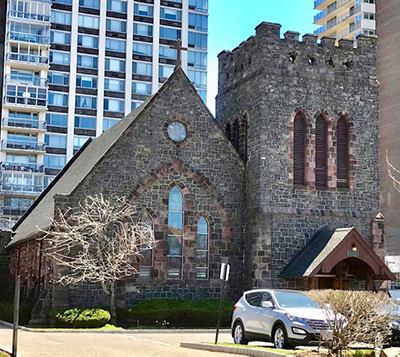


The Church Of The Good Shepherd
There is a place for you here.

The Grace of Living Today
Today’s Gospel is the story of Lazarus. Jesus calls back a man who has already been laid in the tomb. Because this is such a well-known miracle story, we often think first of the ending: the moment when the dead man comes out again. But the Gospel of John does not take us there at once. It first leads us into sorrow. It brings us near those who stand before death.
Martha and Mary have lost someone they love. They are facing a reality that cannot be undone. What they need first is not an explanation, and not many words. They need someone who will stay with them in that place. That is where today’s Gospel begins.
When something unusual happens before our eyes, our attention quickly goes there. We notice what is striking. We pay attention to what surprises us. But the heart of today’s Gospel is not simply the visible result of the miracle. Before the miracle, the Gospel shows us Jesus in sorrow.
Before Jesus raises Lazarus, he first weeps. “Jesus began to weep.” These few words matter deeply. Jesus does not step around sorrow. When people stand before death, they often try to understand their grief. They try to find words of comfort for one another. But Jesus first weeps.
God is not one who stays far away and sends help from a distance. God does not simply look at our pain from the outside. The life God gives does not ignore our human sorrow. It is not empty comfort. It is not a life untouched by suffering.
So faith does not begin only after everything has been resolved. It does not begin only after every wound has healed. God is with us in that very place where sorrow still remains, where hearts are still hurting. Faith begins again there.
And then Jesus says, “I am the resurrection and the life.” These words are not only about the last day. Jesus does not simply speak about life. He comes among us as life itself. Where the Lord is present, life is not left as a promise for some far-off future. It begins here and now.
We often think of life simply as the opposite of death. We think first of breathing, moving, and staying alive. But the life spoken of in the Gospel is deeper than that. It is life made new in relationship with God. It is more than physical survival. It is the strength to rise again in God. It is the grace that enables us to keep going even when sorrow weighs on the heart.
The story of Lazarus is not only about a dead man being raised. It also shows us when life begins. Life is not only something given later. It has already entered our lives. Even when everything has not been solved, even when much is still unfinished, if the Lord is with us, life has already begun.
And yet we are often quick to respond to what is dramatic, while missing the meaning of what is quiet and ordinary. The same truth can look very different depending on where we meet it. In a special place, and at a special moment, people often recognize what is precious. But in an ordinary place, in a familiar day, in the repeated rhythm of life, we may fail to see what matters even more.
We long for some clear sign of grace. Sometimes we hope for one event that will change our lives all at once. Of course, God sometimes comes to us in unexpected ways. But more often, God meets us quietly, in familiar days,
1
in places we are likely to overlook. The problem is not that God is far away. The problem is that we do not always recognize the meaning of the place where we already stand.
We often live while waiting for some other day. When we are young, we think life will become better once this season passes. Later we think life will change once this one thing is achieved. At other times we tell ourselves that once this trouble passes, once this burden is lifted, then we will finally begin to live. And so we keep looking toward a day that has not yet come.
But when we look back, we begin to see that our lives were not made only of a few special moments. Most of life was made of ordinary days. A simple meal. A conversation over a cup of tea. A road we walked many times. The people who stayed beside us. The turning of the seasons. The repeated rhythm of daily life. These are the things that make a life. Very often we understand this only later. Life was not found only in the special days we were
waiting for. It was also there in the many days we passed by without much thought.
The only time actually given to us is today. The past is already gone, and the future has not yet come. We always live this one day. God meets us now. God gives life now. So today is not just another passing day. It is the time when the grace of God touches our lives.
That is why living one day is never a small thing. Doing what must be done. Enduring even in sorrow. Noticing a small joy. Speaking to someone. Cherishing the people near us. Quietly carrying the work given to us. None of this is merely routine. It is life lived with God.
We keep looking for what is special. But even if miracles are rare, life is given to us every day. What is precious does not come only in dramatic ways. Very often it is already before us in familiar places.
Some years ago, a world-famous violinist played in a busy subway passage during the morning rush hour, without telling people who he was. Most people walked past without stopping. Only a few paused for a moment to listen. It was not because the music was poor. It was because people did not expect to meet beauty in such a place. It was not a concert hall. There was no stage, no special lighting, no setting people had been taught to notice. And so
they passed by the beauty before them.
We look for visible miracles and clear changes, yet we may pass by the Lord who is with us in the place of tears. We may fail to see the grace given in a quiet day, the strength that helps us endure, the love that holds us together so that we do not fall apart. But this is where the Gospel begins: the Lord weeping at the tomb, and the Lord speaking life in that same place. That Lord is with us today.
For this reason, Christian faith cannot be a faith that looks only to the distant future. We wait for the fullness of the resurrection. But that waiting does not empty out today. It teaches us to live today more deeply. It teaches us to trust that the life of God has already begun here and now.
So what we should seek is not only a special miracle. We should ask for eyes to see the life already given to us. We should ask for a heart that can see that this place, too, is God’s place. Even if things are not complete, even if some burdens still remain, we are called to trust that this day is not empty in God.
God does not give us only special moments. God gives us repeated days. And God is with us in them. To live today, to endure today, and to receive today in faith—this too is a life held in grace.
Amen.
2
Faith That Learns to See
As Jesus walked along, he saw a man who had been blind from birth. When the disciples saw him, they asked, “Rabbi, who sinned, this man or his parents, that he was born blind?” For people in that time, this must have seemed like a very natural question, because many believed that suffering was the result of sin.
In fact, in life we often try to find the cause of what happens. We ask why something happened, where things went wrong, and what we should learn so that we do not repeat the same mistake again. In that sense, there is nothing wrong with looking for causes. In many situations it is necessary.
But the problem is that even when we stand before another person’s suffering, we often try to reach a quick conclusion in the same way. When we meet pain that is hard to explain, we want to speak as if we already understand why it happened and what it means. We want to make sense of it quickly. We want to say who is responsible and what went wrong. In truth, we do this partly because it makes us feel less uncertain.
This way of thinking also appears in religious life. Sometimes we are tempted to say that something happened because someone’s faith was weak, or because a person had not been faithful enough. But this is exactly where we must be careful. Looking for causes is not the same as quickly deciding that another person’s suffering is simply a matter of sin and punishment.
Jesus stops that kind of thinking.
“Neither this man nor his parents sinned.”
Jesus is not simply correcting the disciples’ question. He is changing the way they see suffering. He stops the habit of asking too quickly who is at fault, and he tells us not to explain another person’s pain too easily by our own judgment.
So we must be able to say that we do not know. To say “I do not know” is not a sign of weak faith or irresponsibility. Sometimes it is a sign of humility. Refusing to claim that we understand the will of God may not be the absence of faith. It may be the beginning of deeper faith.
Both in good times and in painful times, we should be careful not to decide too quickly what God’s will must be. Yet this does not mean that the difference between good and evil disappears. Faith still teaches us to cherish what is good and to resist what is wrong. But recognizing right and wrong is not the same as declaring that a particular person’s suffering must be God’s judgment. Life is not explained so easily. We may find ourselves wanting to understand painful things as punishment and good things as blessing. But when we speak too quickly of blessing and punishment, we may place a heavy burden on those who are already suffering. Faith is not a way of quickly defining everything that happens to us. Faith is closer to walking with trust in God, even when much remains unclear.
Then Jesus says,
“He was born blind so that God’s works might be revealed in him.”
We should not hear these words as if they fully explain the man’s suffering. We should not take them to mean that his suffering is now fully explained. Rather, they remind us that even in a dark and painful place, God’s work can still be revealed. Instead of searching further for the cause, Jesus helps us see how the work of God may be revealed here and now.
We want to know the reason first, but Jesus first looks at the person himself. Others tried to explain his situation, but Jesus saw that even there God was at work.
1
Jesus spat on the ground, made mud with the dust, put it on the man’s eyes, and told him to go and wash in the pool of Siloam. He went, washed, and came back able to see. But this story is not only about physical sight. It is also about slowly coming to know who Jesus is.
At first the man speaks of “the man called Jesus.” Later he says, “He is a prophet.” And in the end he says, “Lord, I believe.” His eyes seem to open all at once, but his faith opens slowly. First his physical eyes are opened. Then the eyes of his heart begin to open. Faith often grows in the same way. We do not understand everything at once. We begin to see more clearly, little by little.
There are other people in this story as well. The Pharisees do not rejoice when the man receives his sight. They are more concerned that this happened on the sabbath than that a blind man can now see. In one sense, they do see. They have eyes, learning, and religious confidence. But they fail to see what matters most. They do not see that the work of God is happening right in front of them.
Jesus’ final words make this even clearer:
“I came into this world for judgment so that those who do not see may see, and those who do see may become blind.”
These words challenge the false certainty of those who think they already see clearly. Anyone with eyes can look at things, but true sight is not so simple. We may all look at the same event and still understand it differently. We can become far too sure of our own interpretation.
This temptation does not appear only in personal suffering or in religious life. We also see it in the way we respond to public events. We see the same pattern when we hear news of war and conflict in our own time. We are often quick to decide who is right and who is wrong. Yet what seems clear to me may only be one small part of a much larger reality. To live as Christians is to be called into a life that sees more slowly, listens more carefully, and reflects more deeply. Before we rush to divide the world into right and wrong, we may need to recognize the limits of our own judgment. If we are to speak of justice and peace, that speech should begin with humility—with the quiet awareness that I, too, may be mistaken.
Those who know that they do not see clearly may begin to see in a new way. But those who are certain that they already see clearly leave no room for new light. The repentance of Lent is like this. It is laying down before God the old ways through which we have judged and interpreted the world. It is not only about correcting bad habits. It is also about examining the very way we see.
In the end, the man in today’s Gospel meets Jesus again. And at last he says,
“Lord, I believe.”
This is not the voice of someone who now understands everything. It is the voice of someone who has only now begun to see. He no longer sees only through his own judgment. He begins to see by following Jesus.
As we walk the road of Lent, we also need this kind of prayer: not eyes that judge quickly, but eyes that understand; not a heart that rushes to explain suffering, but a heart that stays with those who suffer; not eyes that think they already know, but eyes that are opened again to learn in the presence of the Lord.
May God open our eyes.
May Christ lead us into the light.
And may we also learn, little by little, to say with humble faith,
“Lord, I believe.”
Amen.
2
The Gift of Living Water
Jesus is sitting by a well in Samaria. He is tired from the journey, and it is about noon. A woman comes to draw water. Nothing about the scene seems unusual at first. There is no crowd, no miracle, no public attention. Only a tired man, a woman with her jar, and a well in the middle of the day. Yet this quiet moment becomes the beginning of a changed life.
Jesus says to her, “Give me a drink.” It is a simple sentence, but it crosses a deep boundary. A Jewish man would not normally begin a conversation with a Samaritan woman. Too much stood between them. There was a long history of distrust, division, and wounded memory. Most people would have kept their distance. Jesus does not. This is how grace often begins. Not in a dramatic way, but in a quiet opening. A barrier begins to give way. A conversation begins where silence had ruled before.
At first, the woman hears Jesus in the most ordinary sense. She sees the well. She sees that he has nothing to draw water with. She hears his words, but she does not yet hear what lies within them. Jesus is speaking about more than the water in the well. He is speaking about the thirst that returns again and again, even after we think we have found relief. That part of the story is not far from us. We know what it is to be thirsty. Not only in body, but in spirit. A person may continue with work, family, and daily duties, and yet feel worn within. Sometimes the heart grows dry through grief. Sometimes through disappointment. Sometimes simply through the strain of carrying life for a long time without rest.
When that happens, we try to manage as best we can. We keep busy. We hold on to familiar things. We look for something that will calm us, steady us, or make us feel safe again. Some of those things may help for a while. But they cannot give the life that the soul needs. That is where Jesus meets this woman. And that is where he meets us. He speaks to the part of life that remains restless, even when everything on the surface seems under control. He speaks to the place in us that grows tired of returning to the same well, hoping that this time it will be enough.
The woman says she wants this water, though she still does not understand. She is thinking simply and practically. She hopes life may become easier. She hopes she may not have to keep coming back to draw water. There is nothing strange about that response. It is how faith often begins. Not in full understanding, but in need. Not in strength, but in weariness. A person turns toward God because something has become too heavy, too empty, or too dry to ignore. Jesus does not reject such a beginning. He does not wait for perfect faith. He stays with her and leads her further.
Then the conversation turns to the woman’s life. Jesus begins to speak about her life more directly. This is not meant to shame her. He does not expose her in order to humiliate her. He simply brings truth into the open. And truth, in the presence of Christ, is different from condemnation. Many of us know how to hide. We hide regret. We hide hurt. We hide the parts of our lives that feel broken, unfinished, or difficult to explain. Sometimes we do this before other people. Sometimes we do it even before God. Yet nothing begins to heal while everything remains hidden. The woman discovers that being known by Christ does not destroy her. It frees her to stand honestly before him. That is where change begins.
From there, the conversation turns to worship. The old question comes quickly: where is the right place to worship? On this mountain, or in Jerusalem? It is an ancient dispute, but the instinct is still familiar. 1
People still ask which tradition is right, which form is best, where true holiness is found. Jesus does not dismiss worship itself. Place matters. Tradition matters. The Church does not live without form, memory, and order. These things carry faith from one generation to another. But Jesus takes the question deeper. The heart of worship is not simply the right place. The heart of worship is meeting God in truth.
True worship begins when we stop pretending. We come before God as we are, not only with our gratitude and strength, but also with our need and weakness. We do not stand before God with a polished surface. We stand before God with our real life. That is why worship is more than duty. It is more than form. It is the place where God meets us again and gives life to what has grown tired within us.
At this point, we may remember the story from Exodus. In the wilderness, the people are thirsty. They complain. They quarrel. They ask whether God is really with them. It is not a noble moment. Even so, God gives water from the rock. Their confusion is real, but God’s mercy is greater. The woman at the
well is not so different. She does not arrive with settled faith or clear understanding. She comes with ordinary needs, limited vision, and the weight of her own life. Still, Christ begins with her there.
This is one of the deep comforts of the Gospel: before we find our way to God, God has already come near to us. Before our faith becomes steady, grace is already at work. Before we speak honestly, Christ has already met us where we are. So this Gospel asks us a simple question: where are we trying to satisfy our thirst? What do we keep returning to, hoping it will finally give peace? What helps for a moment, but leaves the heart empty again?
Lent gives us space to ask such questions honestly. It is not meant to lead us into despair. It is meant to help us see more clearly. If something in us has grown dry, that is not the end. It may be the very place where we become ready to receive the living water of Christ. That is why this Gospel is good news for ordinary people. For tired people. For those who carry disappointment quietly. For those who keep going, even when something within has begun to fade.
The Lord who met a Samaritan woman at a well still comes to people in the middle of ordinary life. He comes with patience. He comes with truth. He comes with mercy. And so we come to the Eucharist. We do not come because we have made ourselves whole. We come because we need grace. We come with our faith, but also with our weakness. We come with hope, but also with need. And here Christ meets us again.
So may this holy table become for us what the well became for that woman: the place where Christ meets us as we are, the place where truth is not used to wound us, and the place where grace begins to open what has long been closed. May the living water of Christ rise within us, not as a passing feeling, but as the life of God renewing us from within. And may what has grown dry in us begin, by the mercy of God, to live again.
Amen.
2


Congratulations! Jonathan Woolley! March 1, 2026
In the Wilderness of Trust
Jesus was led up by the Spirit into the wilderness to be tempted by the devil. “He fasted forty days and forty nights, and afterwards he was famished.” (Matthew 4:2) At that very moment of weakness, the tempter comes and says, “If you are the Son of God, command these stones to become loaves of bread.” (Matthew 4:3)
This is not only about hunger. It is about proof. It is a voice that says, “If you are the Son, prove it.” It is a temptation to test God instead of trusting God. It whispers, “If your need is not met now, maybe God cannot be trusted.”
We know moments like this. The body is tired. The heart is anxious. The future feels blocked. In such times, faith can slowly turn into a demand for proof.
Jesus answers, “It is written, ‘One does not live by bread alone, but by every word that comes from the mouth of God.’” (Matthew 4:4)
Jesus does not deny hunger. He does not pretend that bread is unimportant. But he says we do not live by bread alone. Immediate need does not govern his whole life. God’s word is not a quick fix that removes every problem. It is the strength that keeps us from letting go of God in the middle of our problems.
The devil does not stop. He takes Jesus to the holy city and places him on the pinnacle of the temple and says, “If you are the Son of God, throw yourself down; for it is written, ‘He will command his angels concerning you,’ and ‘On their hands they will bear you up, so that you will not dash your foot against a stone.’” (Matthew 4:6)
It is a demand for visible proof. Something clear. Something we cannot miss.
When we are anxious, we also want clear signs. We want prayer to bring quick answers. We want faith to produce visible results. But Jesus says, “Again it is written, ‘Do not put the Lord your God to the test.’” (Matthew 4:7)
Testing God is not always unbelief. Sometimes it is faith with conditions. “If you do this, then I will trust you.” Jesus refuses that path. God is not an object to be tested. God is the One we lean on.
Finally, the devil takes him to a very high mountain and shows him all the kingdoms of the world and their splendor. He says, “All these I will give you, if you will fall down and worship me.” (Matthew 4:9)
Here the temptation is direct. The result will be good, so the method does not matter. Quick success. Great influence. Public glory. A crown without a cross.
Jesus says, “Away with you, Satan! for it is written, ‘Worship the Lord your God, and serve only him.’” (Matthew 4:10)
The three temptations are not three separate stories. They are one pressure, coming in different voices. They try to move God away from the center. They put need first, and they demand proof. And, almost without our noticing, they lead us to trust something else more than God. They do not say, “Do not believe in God.” They say, “There is something more reliable than God.”
1
This is an old temptation—older than we think. We have heard this voice before, at the beginning of the story.
We hear a similar voice in Genesis. The serpent says to the woman, “Did God say, ‘You shall not eat from any tree in the garden’?” (Genesis 3:1) But God had said, “You may freely eat of every tree of the garden; but of the tree of the knowledge of good and evil you shall not eat.” (Genesis 2:16–17) The serpent twists the word. What was generous becomes restrictive. What was good becomes doubtful. And then the woman sees the tree differently. “So when the woman saw that the tree was good for food, and that it was a delight to the eyes, and that the tree was to be desired to make one wise, she took of its fruit and ate.” (Genesis 3:6) “The eyes of both were opened, and they knew that they were naked.” (Genesis 3:7)
Their eyes are opened, but what they see first is fear. Instead of freedom, they hide.
Psalm 32 speaks about this hiding. “While I held my tongue, my bones withered away, because of my groaning all day long. For your hand was heavy upon me day and night; my moisture was dried up as in the heat of summer.” (Psalm 32:3–4) Hiding does not make us stronger. It dries us out. It turns the heart inward until even prayer feels difficult.
But the psalm continues: “Then I acknowledged my sin to you, and did not conceal my guilt. I said, ‘I will confess my transgressions to the Lord.’ Then you forgave me the guilt of my sin.” (Psalm 32:5)
Confession is not persuading God. It is coming back to stand before God again. It means turning around from the place where we were running away, and stepping into the light, so that God may meet us where we really are.
Paul names this turning in a larger way: “For just as by the one man’s disobedience the many were made sinners, so by the one man’s obedience the many will be made righteous.” (Romans 5:19) What Jesus does in the wilderness is not simply passing a test. Where we fail, he chooses obedience. When we begin to doubt, he keeps trusting. And when we waver, he remains faithful.
And the Gospel ends with a quiet detail: “Then the devil left him, and suddenly angels came and waited on him.” (Matthew 4:11) Jesus does not prove himself. He refuses to test God. He turns away from every false worship, and keeps God at the center.
Lent is not a season to prove that we are strong. It is a season to notice where we are weak, where we are tempted to trust something else more than God.
When a wilderness moment comes, we may ask ourselves: Am I looking for trust, or for proof? Am I holding on to God, or to something else?
And we may also pray in a simpler way: Lord, teach us the quiet courage to trust. Give us grace to return, not to perform.
Today the Gospel tells us that even in the wilderness, there is a path. Not a fast path. A path of trust. Not proof, but trust. Not hiding, but confession.
“You are my hiding-place; you preserve me from trouble.” (Psalm 32:7)
May this confession be our prayer during this holy Lent. Amen.
2
Coming Down the Mountain
Jesus took Peter and James and his brother John “up a high mountain, by themselves.” (Matthew 17:1) On that mountain, the three disciples saw something they had never seen before. “He was transfigured before them, and his face shone like the sun, and his clothes became dazzling white.” (Matthew 17:2) And then—“Suddenly there appeared to them Moses and Elijah, talking with him.” (Matthew 17:3)
It is not an accident that those two appear. Moses belongs to the story of the covenant—the law given on the mountain at Sinai, the people led out of slavery, the long work of learning to live as God’s people. Elijah belongs to the story of the prophets—the voice that calls a nation back, the fire of truth, the courage to stand when faith grows thin; and that courage was renewed on Horeb, when he heard God’s quiet call again. Both of them knew mountains. Both of them knew the hiddenness of God. And now, on this mountain, they do not draw attention to themselves. They speak with Jesus. As if the Scriptures are saying, quietly and clearly: everything we have received—law and promise, warning and hope—is moving toward him.
Peter spoke first. “Lord, it is good for us to be here; if you wish, I will make three dwellings here, one for you, one for Moses, and one for Elijah.” (Matthew 17:4) We understand his heart. When a moment is good, we want it to last. When prayer brings peace, we quietly think—If only we could stay here.
But the Gospel does not let them stay there. Right then, “a bright cloud overshadowed them,” and a voice spoke out of the cloud: “This is my Son, the Beloved; with him I am well pleased; listen to him!” (Matthew 17:5) God does not tell them to remain on the mountain. The center of the mountain is not the feeling. It is the voice that speaks—and that voice gives direction.
And “listen” does not mean only hearing sound with our ears. In the Bible, to listen is to receive the word with a willing heart, and to follow the One who speaks. So “listen to him” means this: Do not cling to what you saw. Do not build your faith on a single bright moment. Follow Jesus—especially as you come down the mountain.
We see a similar pattern in Exodus. The Lord calls Moses up the mountain and says, “Come up to me on the mountain, and wait there; and I will give you the tablets of stone… which I have written for their instruction.” (Exodus 24:12) The mountain is not a place where we go to prove ourselves. It is a place where God calls, and we learn to listen. The light is given not as a reward, but as a gift—so that we
can hear more clearly, and then live differently.
1
Peter’s desire was human. But if we stop there, we can lose the way. Jesus did not come to remain on the mountain. He came down, and he went toward Jerusalem. He walked the road that leads through the cross—and into resurrection life.
When the disciples heard the voice, “they fell to the ground and were overcome by fear.” (Matthew 17:6) Fear in God’s presence is not strange. We feel small. Words fail us. But Jesus does not stay far away. He comes close. “Jesus came and touched them, saying, ‘Get up and do not be afraid.’” (Matthew 17:7) So faith that listens is not a quiet moment that ends on the mountain. It is listening that leads to the next step—even when fear is still there.
Then the Gospel gives us the clearest line of all: “when they looked up, they saw no one except Jesus himself alone.” (Matthew 17:8) Moses is gone. Elijah is gone. The cloud is gone. In the end, only Jesus remains. When faith becomes complicated, this brings us back to what is simple: the words of Jesus, and the touch of Jesus.
And the story does not end at the top. It turns us toward the road again. “As they were coming down the mountain, Jesus ordered them, ‘Tell no one about the vision until after the Son of Man has been raised from the dead.’” (Matthew 17:9) The light of the mountain is understood fully only after the cross and the resurrection. Some things need time to deepen in the heart. But the direction is not delayed. Even before we understand everything, we are still called to follow. So what remains for us is not only a memory of the mountain. What remains is the word we carry as we come down.
Down the mountain, the voices return. The ordinary pressures return. Our hearts are easily shaken. That is why the word of Jesus matters. It brings us back to a simple question: What is faithful here? What is loving here? To listen is not to be moved for a moment and then return to the same life untouched. To listen is to let the word become today’s step—to ask again: What should I hold on to? What should I release?
This Sunday stands at the door of Lent. In a few days, we will come for ashes, and we will hear words that are honest and humbling. Ashes do not deny the light. They tell the truth about us. They remind us that we are not self-made, and not self-saving. They bring us back to reality—so that grace can meet us there. But today—before we enter that season—the Gospel gives us light. Not so that we can escape the world, but so that we can follow Jesus more faithfully within it. The light from the mountain does not remove all darkness at once. But it puts us back on the road. It helps us remember what matters. It gives us strength to walk again. And the Gospel leaves us with what is simple: “This is my Son, the Beloved… listen to him!” (Matthew 17:5) “Get up and do not be afraid.” (Matthew 17:7) So we do not hold on to the satisfaction of the mountain. We hold on to the word of Jesus. And we walk again in the ordinary place where we live each day—following that word, coming down the mountain. Amen.
2
Light Reveals Itself Quietly
Jesus says to his disciples,
“You are the salt of the earth.”
“You are the light of the world.”
(Matthew 5:13–14)
These words sound less like a command and more like a calling. Jesus does not say, “Live like this, and then you will become salt and light.” He simply says, “You are.”
He does not begin by measuring the disciples’ readiness. He simply receives them as they are and names who they already are.
This is not a judgment of their ability, nor a reward for their success. It is a gift given before any action, before any result. Before we show anything to God, God first calls us. And this matters because so much of our life runs on the opposite logic. We are trained to earn a name, to prove our worth, and to secure our place. Even our faith can slip into that pattern, quietly, without our noticing. We begin to think God’s love must be deserved, or God’s closeness must be achieved. But Jesus begins somewhere else—with grace. He gives an identity before he asks for a response. Salt does not draw attention to itself. It does not announce its importance. It mixes into the meal. And yet, without salt, the meal quickly loses its taste, and it does not keep. No matter how carefully it is prepared, without salt it does not last. Salt’s role is not to stand out, but to work quietly from within. The life of a disciple is like this. It is not a life that stands above the world to judge it, but a life that enters the world and stays with it. Light is not so different from salt. Light does not defeat darkness by becoming dark itself. It simply shines. This does not mean we ignore suffering or injustice. It means we keep our hearts from hardening. We refuse to become what we resist. And in that presence, the space is no longer the same. Light does not need to prove itself. By being there, it changes what can be seen. When Jesus speaks of salt and light, he is not talking about strong influence or visible success. He is pointing to a faithful way of life—steady, patient, and true. A life lived right in the middle of the world.
That is why Jesus continues,
“In the same way, let your light shine before others,
so that they may see your good works
and give glory to your Father in heaven.”
(Matthew 5:16) These “good works” are not a performance, but the fruit of a life grounded in grace. What matters here is not the size of the good works or whether they attract attention. What matters is where they point. Light does not stay focused on itself. It shines, and through that light, people’s eyes are turned toward God.
1
As we approach Lent, one story comes to mind. I have been reading The Brothers Karamazov by Dostoevsky. Alyosha, one of the novel’s characters, helps me see what Jesus means by a life that shines without trying to be seen. He does not explain his faith at length. Instead of trying to persuade others or prove that he is right, he simply stays with people. He remains beside those who are wounded, beside those who are confused, often without many words. His faith appears more in his way of being than in his arguments. And slowly, the people around him begin to change, not dramatically, but little by little. The direction of their lives shifts. This is not because of what Alyosha achieves, but because of who he is for others in that place. His faith is like light: quiet, steady, and real.
And Scripture speaks in the same direction: not as a slogan, but as a way of life. The prophet Isaiah speaks in a similar way:
“Then your light shall break forth like the dawn.”
(Isaiah 58:8)
Isaiah is not speaking to people who never worshiped. They did worship. They did fast. They used religious language. But something had come apart. Worship was here, and life was somewhere else. And when faith is divided like that, it can become strangely untouched, active on the surface, yet disconnected at the center.
“You serve your own interest on your fast day,
and oppress all your workers.”
(Isaiah 58:3) The problem was not the lack of worship or prayer. The problem was that faith had become separated from life.
So God speaks again about the meaning of fasting:
“Is not this the fast that I choose:
to loose the bonds of injustice,
to undo the thongs of the yoke?”
(Isaiah 58:6) What God desires is not more religious activity, but a faith that moves in the right direction. To draw near to God is not to add more things, but to examine what our lives are truly oriented toward. Lent is a time for this kind of reflection. It is not about becoming impressive, but about becoming true. It is not a season for gathering more, but a season for letting go. We know how easily we can lose our way. It is a time to look honestly at what guides our lives, what we follow, and what truly leads us. This is why Jesus says, “You are the light.” Light does not perform. It simply remains—and shines. And through that light, people are gently led to God. As we stand at the doorway of Lent, Jesus’ call to us is the same. He does not ask us to become brighter or more noticeable. He calls us to live as salt and light, right where we are.
That is enough for this day.
Amen.
2
Come and See
Today’s Gospel begins very quietly. John does not stir up the crowd. He does not offer a long explanation. He simply looks at Jesus and says, “Here is the Lamb of God who takes away the sin of the world.” It is not an explanation. It is a word that points in a direction. John does not draw people toward himself. He turns their attention away from himself and points to where Jesus is.
Faith often begins in this way. It does not begin with certainty. It does not begin with full understanding. It begins when someone quietly points the way, and we take a first step in that direction. We often think that faith means knowing more, understanding more clearly. We assume that only then can we truly believe. But the Gospel shows us another way. It does not ask us to understand first. It does not demand that we reach a conclusion. It simply points in a direction and invites us to take a step. Faith begins there, with a small and almost unnoticed movement.
John then says something else: “I myself did not know him.” This confession matters. John was entrusted with God’s work, yet he did not begin with full knowledge. He did not start with certainty. Our faith is often like this as well. To have believed for a long time does not mean that all questions have disappeared. It may mean, instead, that we have learned to live with our questions. Those questions do not mean that faith has grown weak. John did not know either. Yet he stood where he was and pointed toward the way of God.
When the two disciples hear John speak, they follow Jesus. They do not yet know who he is. They do not know what he will do. They simply follow. Jesus turns and asks them, “What are you looking for?” This is not a test. It is not a question of right or wrong. It is a question that looks into their hearts. They answer, “Rabbi, where are you staying?” It is a simple question. Not a theological one. Not a question about life’s meaning. Just this: Where are you staying? Jesus replies, “Come and see.” He does not explain. He does not give them the right answer. He simply invites them to come with him. The Gospel then says, “They came and saw where he was staying, and they remained with him that day.” Nothing extraordinary happens. No
1
miracle is recorded. No long teaching is given. Only one sentence remains: They remained with him that day.
This short line invites us to reflect. What is faith? It is not a matter of how much we know. It is not a matter of how much we accomplish. The Gospel of John speaks of something more basic: where we remain, whether we stay. In John’s Gospel, discipleship does not begin with a vow or a bold decision. It begins with remaining. Remaining is not easy. We would often prefer clarity, answers, and a clear direction. We want to know where this path will lead. But the Gospel does not give them that. It gives them time—time spent in the presence of Jesus. To remain does not mean doing nothing. It means not running away. It means not rushing to conclusions. When life is unclear, when God’s will is not obvious, it means staying where we are.
In some seasons of life, there is more space for remaining, as our bodies change over time. And we learn that life does not always ask us to do more, but sometimes to stay, to be present, and to remain. Yet the Gospel tells us that this time of remaining can be the time when faith grows deepest.
After remaining with Jesus, one of them, Andrew, goes to find his brother Simon. They may not have spoken much that day. But that day remained with them. Andrew simply says, “We have found the Messiah.” There is no long explanation, only the testimony of having met him. When Simon comes to Jesus, Jesus looks at him and says, “You are Simon son of John. You are to be called Cephas.” Simon is not yet a rock. He will falter. He will fail. But Jesus does not see only who he is now. He sees who he is becoming. A new name is not a demand. It is a promise, a new possibility opened in God.
So it is with us. What we are now is not the whole story. God already sees what we do not yet see in ourselves.
Today’s Gospel speaks quietly to us. Faith is not about grasping distant truths. It is about a life that remains near Jesus. The Eucharist we share today is part of that same invitation. Even now, the Lord says to us, “Come and see.” Remain at the table. Remain long enough. Remain with the Word, with the bread and the wine. And in that remaining, entrust yourself to the God
who is already at work, slowly shaping our lives. Amen.
2
Jesus Standing Among the People
Today we celebrate the Feast of the Baptism of the Lord. On this first Sunday of the season after Epiphany, we return to the scene where Jesus’ public ministry begins. But this beginning is different from what we might expect. There is no great announcement. There is no new teaching yet. At the Jordan River, many people had already gathered. They listened to John the Baptist, looked honestly at their own lives, confessed their sins, and went down into the water to be baptized. Right in the middle of them, Jesus is standing. Without drawing attention, without being set apart, he stands quietly among the people.
The Gospel of Matthew tells this story very simply. Jesus comes from Galilee to the Jordan River. He comes to John to be baptized. For those of us who know who Jesus is, this scene feels unfamiliar. Why does Jesus need to be here at all? That question naturally arises. John the Baptist asks the same question. “I need to be baptized by you, and do you come to me?” John’s words are completely reasonable. Jesus is without sin.
But Jesus answers him, “Let it be so now; for it is proper for us in this way to fulfill all righteousness.” This is not simply an explanation to convince John. It shows us the path Jesus chooses to walk. Jesus does not put himself first. He does not try to prove who he is. Instead, he looks to the will of God. And he already knows where that path will lead him.
The place where Jesus stands is not a place of power over others. It is not a place of self-exaltation. It is a place beside the people. Not a place of judgment, but a place of shared confession. Not a place to set himself apart, but a place where he enters the same water with those who confess their sins. What matters most here is not simply that Jesus was baptized. What matters more is that he did not refuse to stand in that place. Though he was without sin, Jesus willingly chose to fulfill God’s will from the place of sinners.
This choice was not a single act of humility. It clearly reveals the heart of the Incarnation: God entering directly into the center of human life. That the Word became flesh does not only mean that Jesus took on a human body. It means that he entered the very middle of human life, even the place of confession and weakness. This choice shaped the direction of Jesus’ entire life. His way was never to look down from above, but to go down and stand with others. 1
This path had already been foretold long ago. In Isaiah, God says, “Here is my servant, whom I uphold, my chosen, in whom my soul delights;” And then God continues, “He will not cry or lift up his voice, or make it heard in the street; a bruised reed he will not break, and a dimly burning wick he will not quench;” God’s servant does not stand above others. He does not break an already bruised reed. He does not quickly extinguish a dimly burning wick. He remains quietly beside them and stays with them to the very end.
The baptism of Jesus was the moment he accepted this servant’s path as his own. And upon that choice, God’s response follows. When Jesus comes up from the water, the heavens are opened. The Spirit descends like a dove. And a voice from heaven is heard, “This is my Son, the Beloved, with whom I am well pleased.” This voice does not give Jesus a new identity. He is already the Son of God. What matters is the moment when this voice is spoken.
It is not after a miracle. It is not after the praise of the crowds. It is when Jesus stands among sinners, when he goes down into the water with them, sharing their place. God is pleased with that choice. The path of coming down, not trying to rise above; the path of solidarity, not separation; the path of carrying together, not judging from a distance. This is the path that accords with God’s will. In the Acts of the Apostles, Peter describes Jesus’ life this way: “how God anointed Jesus of Nazareth with the Holy Spirit and with power; how he went about doing good and healing all who were oppressed by the devil, for God was with him.”
The Feast of the Baptism of the Lord asks us a question. What kind of God do we believe in? And where are we standing now? The baptism of Jesus was not the beginning of rising upward. It was not a moment of self-display. It was a choice to go down among the people, a decision to fulfill God’s will from the place of sinners. God was pleased with that choice.
As we take the first steps of the season after Epiphany, the Church stands again before this scene. And we confess this truth: God’s way does not begin in high places. It begins where we come down and stand among the people. On that path, Jesus is already there. And Jesus shows us today that living among others, sharing life at its center, is the way we are called to walk. Amen.
2