A Church Beyond Boundaries
During our vacation, my family and I stayed at campgrounds in Maine and Connecticut. There were many people around us. Other families were staying right beside us and across from us. Each campsite was marked off by thick wooden posts. I paid close attention to those boundaries. I tried not to get too close to them, and I was careful not to disturb our neighbors with noise or activity. On the last day, as we were leaving, I waved to the family at the campsite next to ours. They smiled and waved back. It was only a brief moment. But as we drove away, I found myself thinking about something. We had stayed right next to each other for several days. Yet we had been so careful not to bother one another that we had never really gotten to know each other.
Boundaries are necessary. Respecting another person’s space is part of caring for them. But when all our attention goes toward keeping the boundary, we can live right next to one another and still remain strangers. There are boundaries in today’s Gospel as well. Jesus leaves Galilee and goes to the region of Tyre and Sidon. He moves beyond the familiar world of Jewish life into a region where many Gentiles lived.
There, a woman comes to him. Matthew calls her “a Canaanite woman.” That was not the ordinary way to describe someone in Jesus’ time. In the Gospel of Mark, the same woman is described as Syrophoenician. But Matthew reaches back for an older and heavier name: “Canaanite.” In Israel’s long history, the Canaanites were remembered as a people distinct from Israel. They had lived close to one another and had influenced one another. But their religious and cultural traditions were different, and at times they had been in conflict. And now a woman from beyond that old boundary comes to Jesus.
Unexpectedly, she calls out, “Lord, Son of David.” A Gentile woman, someone considered an outsider, recognizes who Jesus is and comes to him in faith. She pleads with him for her suffering daughter. But at first, Jesus does not answer her at all. Still, she does not leave. She keeps following and crying out. Then the disciples say, “Send her away, for she keeps shouting after us.” To them, she was a stranger. And she continued to stay near them, asking for help. The disciples say, “Send her away.” Her persistent cries must have made them uncomfortable.
But it is exactly here that an old boundary becomes an encounter with a real person. The Gospel asks us how we see the person standing before us. Do we see only the old name, the difference, and the boundary? Or do we see the person who is asking to be heard? The woman continues to ask for help. Jesus says, “It is not fair to take the children’s food and throw it to the dogs.” But she does not give up. She answers, “Yes, Lord, yet even the dogs eat the crumbs that fall from their masters’ table.”
She trusts that God’s mercy can reach even her. She asks for no place of honor. She asks only for mercy for her daughter. And she believes that even a crumb of God’s mercy is enough to bring life. Finally, Jesus says, “Woman, great is your faith! Let it be done for you as you wish.” At the beginning of the story, she is introduced as “a Canaanite woman.” That name carries an old history and an old boundary. But that old name does not have the final word. Her faith does. The woman whom others saw only as a stranger is remembered in the Gospel as a woman of great faith.
Our church has an English-speaking congregation and a Korean-speaking congregation. Our languages are different. The hymns we know and the cultures in which we have lived are also different. So we need to respect one another. But respect does not mean that we must always remain at a careful distance from one another. Even if we do not understand all the English, we can attend the English service. Even if we do not speak Korean, we can sit at a table prepared by the Korean congregation. We can ask the name of someone we do not know. And when words do not come easily, a smile and a greeting can be where we start.
In East Asian architecture and garden design, there is a concept called chagyeong (借景), or “borrowed scenery.” A mountain, a tree, or a stretch of sky beyond a garden wall is allowed to become part of the beauty of the space within. You do not own what lies beyond the wall. And you do not have to tear the wall down. The boundary remains. But the beauty beyond it becomes part of the life within. The space becomes richer because of that relationship.
I think a church can be like that. We can keep our different languages and traditions and still open ourselves to one another. We do not have to erase every difference between us. We can allow the life of others to become part of our life together. And when we do that, our community becomes richer. This is not only about the English-speaking and Korean-speaking congregations.
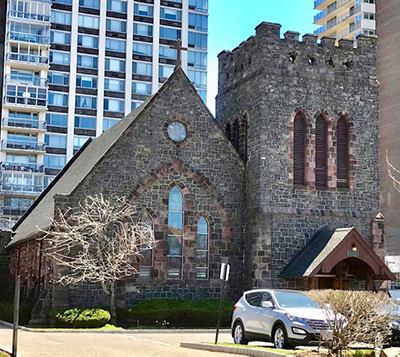
After this service, Joyful Church will worship in this same space. During the week, daycare teachers, children, and parents come through these doors. Another faith community gathers here on Wednesdays, and an AA group meets here on Fridays. Each group’s time and space deserve respect. But I hope we will not think of them only as “people who use our building.” They are people who enter the same doors, walk through the same rooms, and gather beneath the same roof. I hope the different people who come through this place can gradually come to know one another. I hope they can feel that they are not merely using a space, but sharing in the life of this place.
In today’s reading from Isaiah, God says, “For my house shall be called a house of prayer for all peoples.” The holiness of God’s house is not protected by keeping everyone at a distance. It becomes a house of prayer when different people are welcomed before God. This does not mean that every difference disappears. It means our differences no longer have to separate us. A house of prayer for all peoples is not a place where everyone becomes the same. It is a place where different people can stand before the same God and learn to recognize one another.
In a few moments, we will come forward together to the table of the Eucharist. The bread we receive is one. Different as we are, in Christ we are one body. This does not erase our languages, histories, or traditions. But it means that none of those differences needs to keep us as strangers. At this table, we do not receive only a crumb. Christ gives himself to us in the bread and the wine. And the mercy we receive here is not ours to keep for ourselves. It opens our eyes to the people beside us. It teaches us to welcome the stranger and to recognize faith where we did not expect to find it.
May we become a church that respects one another and still reaches toward one another, keeping what is good in our own traditions while opening our lives to the gifts of those beside us. May this be a house of prayer for all peoples—a place where boundaries are respected, but no one has to remain a stranger.
Amen.